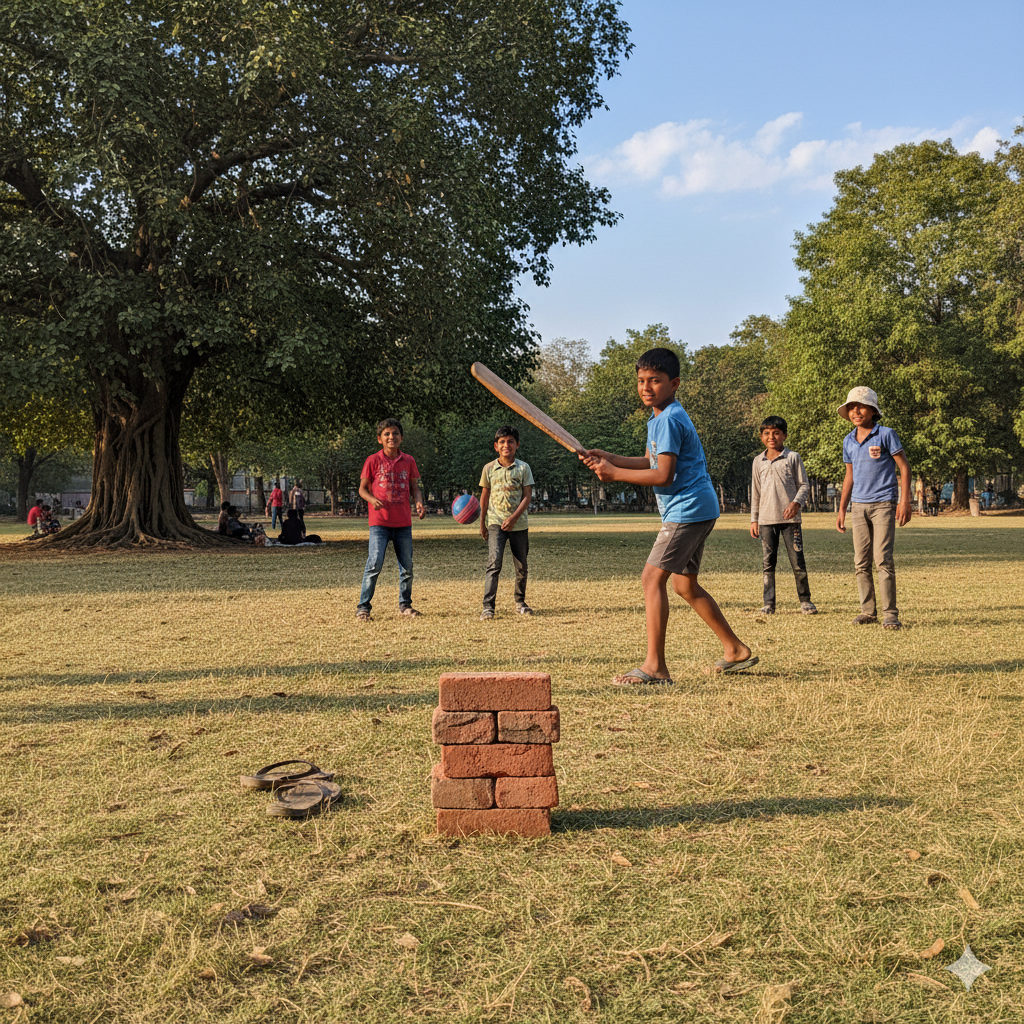
The sun in May hit different back then. By eight in the morning, the gali was already heating up, but we played anyway. No one cared. No sunscreen, no shoes, no hydration breaks. Just an open patch of land tucked behind two blocks in Lajpat Nagar – some called it a park, but it had more dirt than grass. One broken swing. One concrete bench. And right at the edge, a big old tree trunk, slightly tilted, the bark peeling off in layers. That trunk? That was the boundary marker. If your shot crossed the tree on the full, it was six. If it bounced before hitting the bark, four. If it hit the trunk and rolled, you ran.
The stumps were three red bricks. Always bricks. If someone brought a proper stump set, we acted impressed but still trusted the bricks more. Plastic stumps blew over with the wind. Bricks stayed – unless you bowled full pace and clipped the middle one just right, which no one actually did.
That day, there were nine of us. Not ideal, but not bad either. Teams were picked by two captains yelling names across the park. No batting orders, no strategies. You just wanted to be on the side with the better bat and whoever brought the ball. The bat was always someone’s personal pride – a knockoff SS or MRF, usually with the rubber grip peeling off and wrapped tight with black electric tape.
The ball was a green Cosco. Slightly cracked on one side, soft spots from overuse. rishab had brought it. He always did. Ten years old, bata chappals, thin legs covered in dust, and a t-shirt saying rubok. While the rest of us showed up in mismatched home clothes – cotton t-shirts with faded logos and half-track pants – everyone in chappals, floaters or Bata sandals, toes caked in dust by the second over – Kaku wore the same t-shirt every day. He fielded for both sides, bowled only when no one else wanted to, and batted last if he got to bat at all.
But since he brought the ball, no one argued with him. That was the rule.
We didn’t have a coin, so Rinku used a folded piece of a Kurkure packet for the toss. The silver side was heads. It landed silver. Batting.
“Try ball hai na?” someone shouted.
“Haan haan, pehla try ball.”
The first delivery never counted. Always a try ball. Even if you got bowled, even if it was a perfect yorker. Try ball meant: “I’m not warmed up yet, let me mess this one up.”
The first actual ball after the try one was wide. The second one was a no-ball. The third one went straight to Rishab at long-off, who fielded it clean, then gently tossed it back to the bowler from the other team. Claps from the bowler.
The matches were short – six overs per side, unless the ball went missing or Sharma uncle came out yelling from his window.
Arguments were constant. “Out tha!” “Line ke andar tha!” “Maine pakda tha!” “One tip, one hand chal raha hai kya?”
We always said no to “one tip one hand,” unless it was late evening or we were playing with only five people. That day, we had enough to play properly.
The heat was insane. Most of us had sweat patches down our backs by the second over. No one wore dry-fit t-shirts. That was for rich kids in coaching academies. We were playing in cotton shirts so soaked they stuck to your skin by the end of the third over. Someone had brought a bottle of water, but it was warm and smelled faintly of plastic.
By the fifth over, the usual drama had started. Bobby got given out caught behind, even though it clearly hit his pad. He threw the bat down and walked off, sat near the tree, sulking. No one followed him. Five minutes later, he was back, fielding again like nothing happened.
Last over. We needed eleven runs. I was on strike. Rishab was fielding near the trunk, the makeshift boundary.
First ball: dot.
Second: single.
Third: full toss – sliced it, two runs.
Fourth: wide.
Fifth: slower ball, I connected. The ball sailed just over the trunk. Perfect six.
Now we needed two off one.
The bowler came in. I stepped out, tried to loft it straight. Mis-hit. The ball went up high, slowly, and started drifting… straight toward Uncle Sharma’s house.
All of us watched it in silence as it cleared the tree, cleared the wall, and disappeared into his verandah.
“Out,” someone said quietly.
“Check kar lete hain bounce hui thi kya.”
“Seedha gaya bhai. Clean out.”
We didn’t move. No one wanted to ring the bell.
Rishab stood up without a word, jogged to the gate, rang the bell once, then again. Five minutes passed. We heard muffled voices. Then he walked back, ball in hand.
“Uncle bole agli baar aayi toh maarenge.”
That’s all he said. Not angry. Not upset. Just matter-of-fact. He dusted the ball with his shirt, handed it over, and sat on the edge of the bench, staring at nothing but a smile on his face.
It was over. Match done. We lost by one run.
The other team whooped. Rinku shouted something and threw the bat in the air. Someone yelled, “Abe jeeta hua match hara diya!” and everyone cracked up. The noise woke a stray dog, who barked once and then went back to sleep.
But there were no hard feelings. We knew the deal. Losing team treats. Always.
So we started pooling money. Bobby gave ten rupees. I had a 5 rupee and a ten rupee note in my pocket. Rinku added twenty with a dramatic sigh. Prashant ran to the nearby stall and came back with two glass bottles of Coca-Cola, one Thums Up, a packet of Kurkure, and a half-eaten yellow Lay’s we pretended not to notice.
We sat in a lazy circle under the tree, chappals kicked off, dirt on our shins, passing bottles around like they were champagne. Rishab sat with us, sipping slowly, always on the winning side (and the losing side), happy being the common player.
There were no trophies, no scorecards, no coaches—just a cracked Cosco ball, a winning team, a losing team paying for snacks, and a quiet kid who played for both sides like it was nothing.
And somehow, even now, that feels more real than any stadium ever did.